
Some of the links on this page may be affiliate links. As an Amazon associate, I earn from qualifying purchases. There is no additional cost to you when you make a qualifying purchase via an affiliate link. Click here for the full affiliate disclosure.
Why U.S. Manufacturing Output Grew While Jobs Disappeared, and Why Many Americans Still Don’t Know This
For decades, U.S. manufacturing job losses have shaped Americans’ perception of domestic manufacturing. As employment declined, many factories closed or consolidated, and entire regions felt the impact. At the same time, however, the gap between U.S. manufacturing jobs vs. output tells a more complicated story.
Manufacturing output kept rising even as fewer workers were employed. Seeing how those two trends can coexist, how manufacturing has shifted over time, and why the distinction matters is essential to understanding the modern U.S. manufacturing landscape.
While The Great American Manufacturing Disappearance explains which industries and jobs were lost, this piece focuses on how U.S. manufacturing output continued to grow as employment declined, and why that distinction remains widely misunderstood today.
What Most People Think Happened to U.S. Manufacturing
Public perception of U.S. manufacturing has been shaped largely by employment trends. As manufacturing jobs trended down over several decades, many people reasonably concluded that manufacturing itself was disappearing.
Factory closures, layoffs, and the hollowing out of industrial regions were visible and measurable, while production data was not.
This perspective was reinforced by how manufacturing was discussed in the media and politics. Job losses became the primary shorthand for manufacturing decline, even though employment captures only one part of a much larger system. Output, productivity, capital investment, and technology rarely entered the conversation, leaving an incomplete picture of what was actually happening inside U.S. factories.
Several factors shaped how the decline of manufacturing came to be understood:
- Manufacturing job losses were highly visible, affecting entire communities and regions
- Factory closures received more attention than productivity gains
- Employment became the default measure of manufacturing health
- Output and efficiency data were rarely discussed outside academic or policy circles
As a result, manufacturing became widely understood as a sector defined by what it had lost rather than how it had transformed. That assumption continues to shape how Americans discuss domestic production today, even as the structure of manufacturing has shifted in ways that are less obvious but equally important.
The Data That Challenged the Narrative
Manufacturing employment in the United States peaked decades ago, long before many of the most visible factory closures occurred.
From that point forward, job totals declined steadily, reinforcing the idea that manufacturing itself was shrinking. Factory employment became the dominant lens through which manufacturing health was measured, even as other indicators were largely ignored.
But when researchers examined production data alongside employment figures, a different pattern emerged.
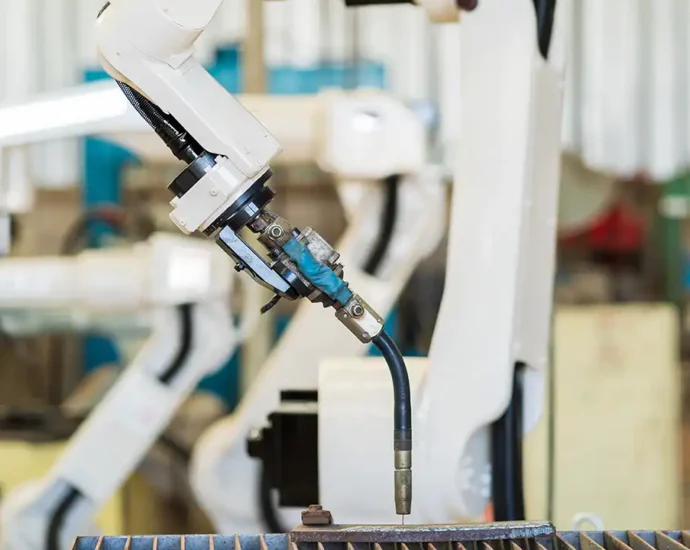
Even as manufacturing jobs declined, total U.S. manufacturing output continued to rise. Fewer workers produced more goods, often at a larger scale and with greater consistency. Advances in automation, process efficiency, and capital investment reshaped factory floors, changing what a “factory job” looked like and how much output each worker could generate. Productivity gains, not workforce growth, became the primary driver of manufacturing expansion.
That disconnect caught many people off guard.
Research published by the Pew Research Center highlighted how closely public perception tracked job losses while overlooking production growth. The findings surprised the public, policymakers, and analysts who had long treated employment as the primary indicator of manufacturing health.
When employment and output were viewed together, the narrative no longer held. Manufacturing didn’t simply disappear. It had undergone a structural transformation, and the data forced a reassessment of what decline actually meant.
How Fewer Workers Made More Goods
Manufacturing output didn’t rise because factories hired more people. It rose because the relationship between labor and production shifted.
This shift didn’t come from a single technology or moment in time. It unfolded gradually as factories changed how work was organized and how capital replaced certain types of labor. Machines took over tasks that once required large teams, while remaining roles became more specialized and technical.
Automation played a role, but it was only part of the story.
Several changes worked together to increase output without expanding the workforce:
- Automation and advanced machinery reduced the labor required for repetitive and precision-based tasks
- Process optimization and lean manufacturing minimized downtime and waste
- Improved logistics and production monitoring allowed factories to run longer and more consistently
- Higher output per worker became the primary driver of growth
Manufacturers invested heavily in advanced equipment, software, and process improvements that increased consistency and reduced waste. Lean manufacturing techniques, improved logistics, and real-time production monitoring allowed factories to produce more with fewer interruptions and less manual oversight. Equipment could run longer, switch tasks faster, and produce more consistent results. As a result, output per worker increased even as total employment declined.
The physical footprint of manufacturing also evolved.
Many companies consolidated operations, replacing multiple smaller plants with fewer high-output facilities. Others adopted flexible production lines that could switch products quickly without expanding staff. These changes altered the on-the-ground landscape of manufacturing, even as production volumes continued to grow.
Job losses were real and concentrated in specific regions and industries. However, the growth in output reflected a structural shift rather than a contradiction. Manufacturing became more productive, not more populated.
Why This Confusion Still Exists Today
Manufacturing output is abstract. Jobs are not.
People experience manufacturing through employment. A plant closes. A shift gets cut. A neighbor loses work. Output data doesn’t appear in daily life in the same way, and it rarely carries the same emotional weight. As a result, job losses became the dominant reference point for interpreting the broader dynamics of manufacturing.
Media coverage reinforced that imbalance. Manufacturing job losses made headlines. Output metrics didn’t. Stories focused on closures, layoffs, and offshoring, often without equal attention to productivity, scale, or total production. Over time, employment trends stood in for the entire sector, even as conditions inside factories continued to change. Those narratives stuck, even when the underlying reality shifted.
Once manufacturing decline became shorthand for job loss, the story proved hard to dislodge. Production could grow quietly. Efficiency could improve without fanfare. But job losses continued to shape public narratives long after the structure of manufacturing had evolved.
Globalization added another layer of confusion. As imported goods became more visible in daily life, many consumers began to equate “Made in China” with “nothing is made here anymore.” What remained less visible were domestic factories producing components, industrial goods, food products, chemicals, and materials that rarely carry consumer-facing labels. Manufacturing didn’t vanish from the economy, but it did move further out of sight.
That gap between visibility and reality is where misunderstanding persists.
Manufacturing changed how it operates, what it produces, and how it employs people. Public perception never fully caught up. The result is a narrative that continues to be told as one of loss alone, even when the data indicate something more complex.
What’s Changed Over the Last Decade
Over the last decade, U.S. manufacturing has been shaped less by a single trend and more by a series of stress tests. COVID-19 exposed global supply chain fragility that had previously appeared efficient. Disruptions exposed how dependent many industries had become on long, tightly optimized networks that left little room for error. Delays, shortages, and bottlenecks forced companies to reconsider assumptions that had long gone largely unchallenged. Reliability, redundancy, and proximity began to carry more weight in manufacturing decisions.
That shift didn’t happen all at once.
Reshoring and nearshoring moved from niche discussions to mainstream considerations. Some production returned to the United States. Some moved closer to end markets. In many cases, companies diversified rather than relocating entirely. What changed most was the assumption that global sourcing should always be the default.
Policy followed the same slow turn.
After decades of limited federal involvement, industrial policy re-entered the conversation. Incentives aimed at strategic industries, domestic capacity, and supply chain security signaled a change in priorities. These efforts didn’t reverse long-term employment trends, but they altered investment patterns and expectations around where manufacturing capacity would be built.
The result has been a manufacturing landscape where output, employment, and capacity no longer move together in obvious ways. Production can rise without large hiring gains. Capacity can be expanded through modernization rather than by building new plants. Investment can increase even as headcounts remain flat.
The last decade didn’t undo earlier changes. It just made them impossible to ignore.
Why Manufacturing Output Isn’t the Same as Manufacturing Jobs
Manufacturing output measures how much is produced. It reflects volume, scale, and productivity.
Manufacturing employment measures how many people are needed to produce it. It reflects how much human work a production system requires.
One tracks goods.
The other tracks labor demand.
When technology, equipment, or processes change, those measures can move in separate directions, sometimes dramatically.
That’s exactly what happened in manufacturing. A factory can increase output without hiring more workers. New equipment can replace repetitive tasks. Processes can tighten. Downtime can shrink. Production can scale up while the workforce gets smaller.
At the same time, rising output doesn’t erase the impact of job loss. Employment matters because jobs anchor communities and regional economies. Output matters because it reflects productive capacity and industrial strength. One speaks to people. The other speaks to systems. Treating them as interchangeable flattens a complex reality into a misleading story.
If output rises, people assume manufacturing is “back.” If jobs fall, they assume it’s gone. Both conclusions miss what’s actually happening inside factories. Manufacturing can modernize, consolidate, and expand production while employing fewer workers than it once did. Looking at output and employment together is the only way to understand what’s changing, what’s being lost, and what’s being rebuilt.
Why This Matters for Made in USA Consumers
How people understand manufacturing shapes how “Made in USA” claims are interpreted.
When manufacturing is widely described as something that disappeared, it can create uncertainty about what domestic production actually looks like today. The idea that “nothing is made here anymore” can narrow how people approach purchasing decisions. If domestic manufacturing is assumed to be rare or symbolic, consumers may be less likely to seek out American-made products. This is where product-level verification becomes important.
Manufacturing didn’t disappear; it became more complex. Some products are fully made in the United States. Others combine domestic and imported components. Company-level claims don’t always capture those differences. Knowing how output, jobs, and production systems work provides context for interpreting labels more accurately.
In the United States, “Made in USA” is a regulated claim with specific requirements, so knowing the FTC’s standards for Made in USA labeling clarifies what those labels mean.
Specific sourcing information, clear disclosures, and product-level detail tend to build more trust than broad statements alone. When consumers understand how modern manufacturing operates, they’re better equipped to recognize meaningful distinctions and make informed choices that align with their priorities.
Common Questions About U.S. Manufacturing, Explained
Why did manufacturing jobs decline if output increased?
Because factories learned how to produce more without adding workers.
Productivity changed the math. Automation, better equipment, and more efficient processes reduced the amount of labor needed per unit produced. Over time, fewer workers could support the same level of output, or even more.
Scale mattered too. Larger, more efficient facilities replaced many smaller ones. Production didn’t stop. It concentrated.
Did U.S. manufacturing really disappear?
It can look that way, and there’s a reason for the confusion.
Many factories did close. Entire industries moved offshore. Communities lost employers that had anchored them for generations. Those losses were real and visible.
At the same time, other parts of manufacturing modernized instead of leaving. Some sectors shrank. Others became more capital-intensive, more automated, or less consumer-facing. Manufacturing didn’t vanish across the board. It restructured unevenly.
Is U.S. manufacturing growing or shrinking?
It depends on what you’re measuring.
Employment tells one story. Output tells another. Capacity, investment, and productivity tell others still. Looking at only one metric almost guarantees the wrong conclusion.
Manufacturing can grow in output while shrinking in jobs. It can expand capacity without reopening legacy plants. The answer isn’t a simple yes or no.
How can manufacturing output grow without more jobs?
Picture the same factory floor, but with fewer people and more machines.
Capital investment replaces certain types of labor. Equipment runs longer. Processes tighten. Waste drops. Output rises without a matching increase in headcount.
That doesn’t mean job losses don’t matter. They do. But it explains how production can scale even when employment doesn’t. Technology, investment, and efficiency transformed how manufacturing works, not just how many people it employs.
The Real Question Isn’t “Did Manufacturing Disappear?”
The better question is what changed, and who benefited from those changes.
Manufacturing didn’t follow a single path. Some industries modernized, investing in automation, scale, and efficiency. They continued producing in the United States, but with fewer workers and different skill requirements. Output remained strong even as the nature of factory work shifted and employment declined.
Other industries moved offshore entirely, particularly in labor-intensive sectors where cost pressures were high and technology couldn’t easily replace human work. In those cases, production left the country for good. Communities built around those industries felt the impact most directly, and many never fully recovered.
At the same time, manufacturing has continued to shift. Reshoring and nearshoring have brought limited production back in certain sectors, often driven by supply chain risk, security concerns, or policy incentives. These returns don’t resemble what existed before. New facilities are more capital-intensive, more automated, and far less labor-dense than the factories they replace.
The benefits of these changes weren’t evenly distributed. Manufacturing evolved in ways that favored companies able to invest, consolidate, and adapt. Consumers benefited through lower prices and more consistent supply. Workers and regions tied to older production models often bore the costs.
That mix of gains, losses, and trade-offs is easy to lose in simplified narratives. Manufacturing didn’t simply disappear or recover. It changed unevenly, producing varied outcomes for distinct groups simultaneously. Those distinctions matter more than settling the question of whether manufacturing is “gone” or “back.”
Understanding Manufacturing Requires Different Questions
American manufacturing didn’t vanish. It changed in ways that altered how goods are produced, how many workers are needed, and where the effects are felt. Output growth and job loss aren’t competing explanations. They describe distinct parts of the same transformation, and neither cancels out the other.
What hasn’t kept pace with those changes is public understanding. Manufacturing is still often discussed through a single lens, usually employment, which makes it harder to see how production, productivity, and capacity have evolved. That gap leaves room for oversimplified conclusions about whether manufacturing is “gone,” “back,” or something in between.
Asking different questions shifts the focus. Rather than debating disappearance or recovery, it is possible to examine what changed, where production still exists, and how modern manufacturing operates. That perspective doesn’t resolve every tension or undo real losses, but it does provide a clearer way to interpret claims, data, and labels tied to domestic production.
Manufacturing today isn’t about choosing optimism or outrage. It’s about paying closer attention to a system that became more complex than the narratives built around it.
Additional Questions People Ask About U.S. Manufacturing
Is U.S. manufacturing output at an all-time high?
U.S. manufacturing output has reached record or near-record levels at various points, depending on how it’s measured and the time period being examined.
What matters more than the headline is the trend. Over time, manufacturing output has grown even as employment declined, reflecting productivity gains and changes in how goods are produced. High output doesn’t mean manufacturing looks the same as it once did, only that it continues to produce at scale.
Why are manufacturing jobs declining in the U.S.?
Because productivity keeps improving faster than labor demand.
Even when manufacturing output grows or stabilizes, employment doesn’t automatically follow. New investment often goes into machinery, software, and process improvements rather than expanding payrolls. As a result, output can rise while job growth remains limited or uneven.
That gap reflects how modern manufacturing works, not a sign that manufacturing has disappeared.
Final Note
This article focuses on how U.S. manufacturing evolved, not on whether those changes were good or bad.
Manufacturing output, employment, and capacity reflect different parts of the system, and none of them tells the full story on its own. Examining them together helps explain why production continued to grow even as manufacturing jobs declined, and why these trends are often misunderstood when viewed in isolation.
This page is intended as a reference for understanding how modern manufacturing works, not as a judgment on the outcomes it produced.
Sources & Further Reading
- Pew Research Center, Most Americans unaware that as U.S. manufacturing jobs have disappeared, output has grown
- U.S. Bureau of Labor Statistics, Industries at a Glance: Manufacturing
- Federal Reserve Economic Data (FRED), Industrial Production Index
- U.S. Census Bureau, Annual Survey of Manufactures (ASM)
- Federal Trade Commission, Complying with the Made in USA Standard




Michelle K. Barto is the founder and lead writer of MadeInTheUSAMatters.com, a site dedicated to helping consumers discover and support products made in the USA. With over 25 years of professional blogging and content creation experience, Michelle combines deep research with firsthand product use to bring readers honest, practical, and engaging reviews alongside easy-to-browse brand and product directories.
Raised with a respect for American craftsmanship, Michelle personally uses and tests many of the products featured on the site — from cookware she uses in her own kitchen to outdoor gear she takes camping with her family. Her mission is simple: make it easier for people to choose quality, American-made goods that support jobs, communities, and manufacturing here at home.
When she’s not writing, you’ll find Michelle working on backyard and home remodeling projects, exploring local parks, or planning the next family adventure in their camper. She lives in Ohio with her husband, youngest son, cat, and a small flock of ducks.